Smarter vehicles, safer mobility, people at the centre.
The first SENSEI newsletter is here, highlighting our initial steps towards more inclusive and trustworthy automated driving!
From our kick-off meeting in Reggio Emilia to our first international collaborations, discover how we’re putting Societal Readiness at the heart of innovation, building connections with All4SR and our sister project AutHUMate, engaging international experts and bringing SENSEI closer to the wider mobility community.
Because the future of automated driving isn’t just about technology. It’s about people.
Want to follow our journey?
Read the SENSEI first newsletter and subscribe to stay updated on our latest developments, research activities, events and opportunities for collaboration!
When a vehicle has several important things to communicate to its driver… what should come first?
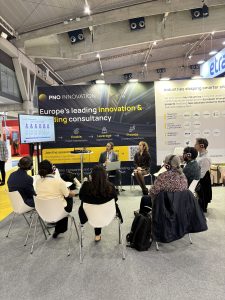
This was one of the questions at the heart of the interactive session “When vehicles adapt to drivers: safety, trust, inclusion and the path to adoption”, organised by PNO Innovation on 5 November at Smart City Expo World Congress 2026 in Barcelona, as part of the Horizon Europe-funded SENSEI project.
Bringing together perspectives from the mobility ecosystem, the session explored a key challenge for the future of automated driving: how can we design intelligent vehicles that adapt to people, rather than expecting people to adapt to technology?
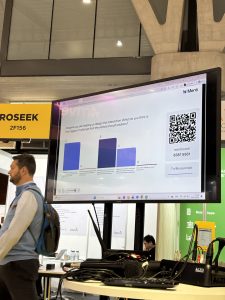
Through a realistic driving scenario involving competing safety alerts, reduced driver attention and accessibility needs, we invited participants to step into the driver’s shoes and reflect on how vehicles should prioritise and communicate information.
The discussion revealed some valuable insights!
Participants emphasised the importance of prioritising safety-critical information, understanding the driver’s context and delivering clear, accessible messages without increasing distraction or information overload.
Because more information doesn’t necessarily mean better communication. What matters is providing the right information, at the right time, in a way that responds to different drivers’ needs.
But developing human-centred technologies is only part of the challenge. How do we turn these innovations into solutions that users trust, industry can implement and the market is ready to adopt?
This is where PNO Innovation’s contribution to SENSEI comes into play: connecting research with stakeholders, exploring opportunities for exploitation and market uptake, and helping bridge the gap between technological development and real-world adoption.
Our session at Smart City Expo was an opportunity to bring these perspectives together, encouraging dialogue on safety, trust, inclusion and the conditions needed to make automated mobility more accessible and widely accepted.
A big thank you to everyone who joined us at the PNO Innovation stand, participated in the interactive polls and shared their perspectives!

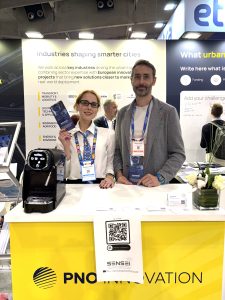
How can we make automated mobility safer, more inclusive, and ready for real-world adoption?
From 3 to 5 November, PNO Innovation will be at Smart City Expo World Congress 2026 in Barcelona, joining international innovators, industry leaders, and mobility stakeholders to explore how innovation can shape smarter, more sustainable, and people-centred cities.
As part of our participation, we are organising a dedicated interactive session within the Horizon Europe-funded SENSEI project, focusing on one of the key challenges of intelligent mobility: how can vehicles adapt to people, rather than expecting people to adapt to technology?
Entitled “When vehicles adapt to drivers: safety, trust, inclusion and the path to adoption”, the session will bring together mobility stakeholders to discuss the opportunities and challenges of human-centred vehicle technologies, from safety, trust, and accessibility to market readiness and real-world deployment.
At PNO Innovation, we believe that bringing innovation to market requires more than technological excellence. It also means understanding users’ needs, overcoming adoption barriers, and connecting research with industry and market opportunities.
Join us at our stand and be part of the conversation!
Where: PNO Innovation Stand 158 – Hall P2, Level 0, Street E – Smart City Expo World Congress, Barcelona
When: 5 November 2026 | 10:00–10:45
Programme and further information: Explore our stand agenda
The SENSEI project (Societal-ready safE and transparent humaN-technology interactionS for the automatEd mobIlity ecosystem) officially kicked off in Reggio Emilia, bringing together 11 partners from six countries to develop the next generation of safe, transparent and human-centred automated driving technologies.
Hosted by the University of Modena and Reggio Emilia (UNIMORE), the two-day Kick-Off Meeting marked the start of an ambitious Horizon Europe project that will redefine Human-Technology Interaction (HTI) for Level 2 and Level 3 automated vehicles.
Over the next three years, the consortium will develop adaptive and personalized interaction systems that help drivers better understand, trust and safely use vehicle automation. Rather than designing technology for people, SENSEI will design it with them, engaging diverse groups of drivers throughout the development process to ensure that future mobility solutions are inclusive, intuitive and responsive to real-world needs.
The project combines expertise in engineering, automotive innovation, artificial intelligence, psychology and social sciences to deliver solutions that are not only technologically advanced but also socially accepted. New adaptive interfaces, personalized training approaches and transparency mechanisms will be tested in both advanced driving simulators and real-world demonstration sites in Germany, Greece, Spain and Türkiye, providing valuable evidence for future deployment across Europe.
Coordinated by the University of Modena and Reggio Emilia (Italy), SENSEI brings together an interdisciplinary consortium of leading academic institutions, research organizations and industrial partners, including Technische Universität Dresden (Germany), UTAC France (France), Vicomtech (Spain), FICOSA Automotive (Spain), EUROGAP (Spain), Fraunhofer-Gesellschaft (Germany), GOTECH Fahrzeugentwicklungs- und Konstruktionsgesellschaft (Germany), the National and Kapodistrian University of Athens (Greece), TOFAŞ Türk Otomobil Fabrikası (Türkiye), and PNO Innovation (Italy).